
Digital Tape is Dead: Bidding “Adieu” to the HDCAM (and its cousins)
[updated comment below-August 28, 2013]
Back in January, I wrote a post called The Independent’s Guide to Film Exhibition and Delivery 2013 examining how rapid technological change was impacting the exhibition side of independent film, and how this was affecting filmmakers’ post-production choices and delivery budgets. At the time, I worried that the solid state digital formats emerging as pre-eminent were simply adding cost to delivery and, in fact, creating a new hierarchy in which Studios were grabbing an even larger share of the market simply by virtue of the fact that the available exhibition real-estate was shifting so rapidly to DCP that it might price out both smaller films and smaller venues unable to afford the changeover to DCP.
But surveying the landscape even seven months ago, it seems I underestimated two critical developments that have overtaken the Industry at a breathtaking rate, seemingly changing the world of exhibition and delivery forever. And lest you think my lack of clairvoyance didn’t matter – I can sum it up this way: had I known what I know now, I would never have invested so much early 2013 money in HDCAMs for our Film Collaborative films.
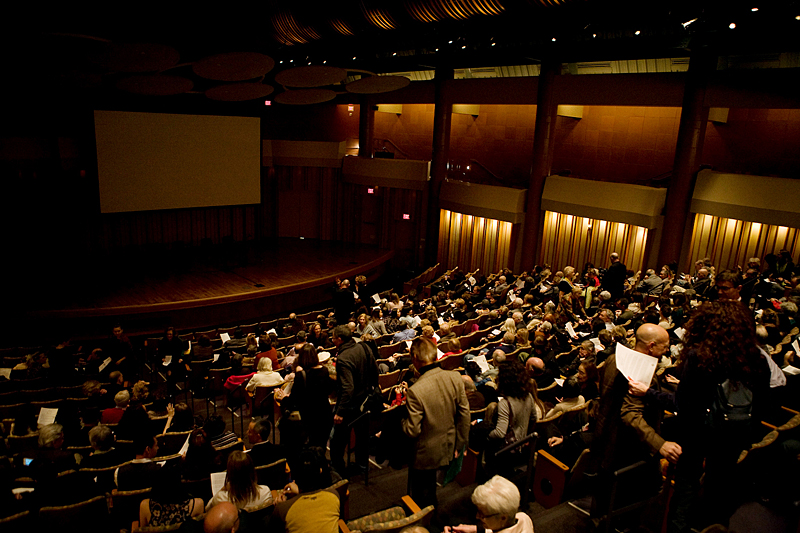
Of the many things that The Film Collaborative does, one of our core services, is booking our clients’ and members’ films in public venues all over the world – including everything from film festivals, traditional theatrical venues, universities, art galleries, etc. When we first got into doing this, of course most of our films had 35mm prints. And of course, those days are long past…digital tape has been the mainstay for some time now…most notably the HDCAM and the Digibeta before it. Disc-based formats (mostly DVD and recently BluRay) had been largely relegated to preview screeners and the smallest of festivals and venues.
As recently as the Sundance Film Festival (January 2013), all of our films showed at that Festival on HDCAM; DCP was still the exception at Sundance; and BluRay was still nearly unthinkable as a respectable format for a major Film Festival anywhere (note: many of the filmmakers we work with still think BluRay is an unacceptable exhibition format). And the general buzz before, during and after Sundance was that DCPs were creating a lot of technical problems at Festivals, and that BluRays of course were even worse.
Now flash forward to the impending Fall 2013, and everything is remarkably different. And I don’t mean subjectively different…as in I think it is different. I mean objectively, measurably, data-driven different, as evidenced by a rather simple breakdown of the data available to us.
Anyone who has had a film on the Festival circuit knows that October is the height of the booking season, the time when all the venues that can’t compete with Berlin or Cannes or Toronto before them, but don’t want to run into the end-of year Holidays typically stage their events (not to mention the flood of Oscar-bait films that are released by the Studios at the end of the year). As such, October offers the best window into the “generic” state of independent exhibition, and is in fact the largest sample size of data available during the year.
This being already late August, most October festivals and venues are locking their October schedules now. And The Film Collaborative films are featured heavily in the Fall 2013 programming schedules, as evidenced by the 195 separate bookings we have secured for our films scheduled thus far for October. I don’t mean 195 screenings mind you, I mean 195 separate engagements across all our films ranging from one day bookings to full theatrical runs.
Of our 195 bookings, the exhibition formats being used for these engagements are as follows (in descending order of frequency):
The takeaway here is staggeringly obvious…in the current independent marketplace –especially in the United States — the BluRay rules far and away above all others. And this is NOT because we are forcing BluRays on venues….in every case we tell Festivals and venues what formats we have AVAILABLE, and largely let them make their choice. And for ALL of our films, we have at least two HDCAMS available….they just aren’t getting used for almost anything! As such, they are just piling up on my shelves…feeling more and more obsolete every day. And I’ll tell you they weren’t exactly cheap to make…especially the ones with fabulously mixed 5.1 sound!
I should clearly note that we do NOT have DCP available for all our films, largely because they are expensive to master and we’ve been able to get away without putting all our films on DCP. But I maintain that this is CRITICAL information for all indie filmmakers who face similar budget choices….clearly one is NOT FORCED by current booking practices to have DCPs available. I can guarantee you we have not lost a single booking due to a festival telling us they can ONLY play DCP (although MANY will tell you they prefer it, especially in Europe).
There is no doubt that if we DID have DCPs available for all our films, that number of DCPs being used in October would change. But I doubt it would shift more than 10%…. Maybe BluRays would go to somewhere like 130 bookings and DCPs to 40 bookings. The difference between the frequency of both formats would still be stark.
I’d also like to say to the naysayers, you’ll note that having CLEAN EXHIBITION QUALITY DVDS are still very important…in fact second most after BluRay. That’s especially true if you wish to show on the University or Gallery or Church or Community Center circuit….a valuable circuit for most niche-oriented independent film. And I’d especially offer this chart to the Festival programmer who electronically yelled at me via email today saying… “DVD is not an exhibition format!” Clearly, a large percentage of venues disagree.
Some of you will ask….why does this matter? Well, the answer (as always) is largely financial…and offers a fascinating look at how the independent film world continues to adapt to the economic realities of competing in a largely studio and movie star-driven industry.
From the venue side of the equation, HDCAM and other tape-based decks were never cheap to rent, so when suddenly given the choice to opt out entirely in favor of a consumer-priced technology like BluRay…the majority of festivals went running to the shallower (cheaper) side of the pool. Clearly, the added stability of showing HDCAMs (which are incredibly reliable) has not been enough to counter-balance the cost-benefit analysis, particularly because BluRays look and sound damn good when projected even across large throws and large rooms. I know that this cost-benefit analysis will remind many of our older readers of the Betamax/VHS era…when it was well known that Betamax was better quality and more reliable, but the cheaper VHS won out completely because of economics.
Add to this the fact that, with current technology, it is DCPs that are the least reliable common exhibition format, and currently lead to the most delayed and cancelled screenings. To date, software ingestion issues, subtitle problems, and encryption code dramas plague independent DCP exhibition…and almost all festivals showing DCPs in fact require BluRay or DVD backups as well!
From the filmmaker side of the equation, the economic forces swaying the state of delivery and exhibition are even more profound. Until recently, it was a given that independent filmmakers were finishing their films on HDCAM and investing in multiple HDCAM copies for exhibition as well as delivery to distributors and broadcasters, platforms etc. But examining the data above, and given that most distributors and platforms prefer now hard drive delivery anyway…why go to HDCAM at all?
Perhaps a post-supervisor could better answer this question, but one conclusion at least remains true from our January 2013 posting….”For the time being, it seems to wisest to counsel that we deliver films as a Quicktime ProRes 422 file available for quick turnaround at a trusted lab with multi-format output capacity. From there, we can be assured of the ability to take our opportunities whenever and wherever they may lead us.”
Back in those old days of January 2013, I made the following statement…”In 2013, the needs of your exhibition formats and delivery formats will likely be determined by how successful your film turns out to be. If your film turns out to be truly theatrical, you will likely need a combination of DCPs and HDCAMs and BluRays to meet the demands.” But as we near the end of 2013, I’m thinking that maybe we don’t need spend all that money quite yet. Lets go a little slower investing in contemporary formats….and check back in at the beginning of 2014 for the third part in this series….and see where we stand then.
Comment:
Hey Jeffrey,
Enjoyed your latest post. Sadly most of it rings true. You struck a nerve touting BluRay. I’m a film festival and post production veteran. You are correct B/R’s are now omnipresent. The demise of tape is tragic actually. Dbeta, HDCAM, SR all bullet proof exhibition formats. You could be reasonably certain if the film was delivered on a pro tape format, some professional editors, colorists etc., had a hand in the film.
Now people deliver exhibition copies on a 33 cent piece of plastic. You are lucky if it comes in a sleeve. Don’t expect labels with TRT’s, audio or aspect ratio information either. If you ask me, the Fukushima accident killed HDCAM and SR, you couldn’t find tape stock so people found another way, but I digress.My concern is the dreaded “can’t read disc” or “no disc” message. We have multiple players for this very frequent occurrence. I need to tell to the film maker I’ve played it in 6 different machines and none of them will read it. I, of course, follow this up with “did you provide a DVD B/U?” I always hear..”well it played on my mac” OMG!
Having spent over a decade as an editor and post supervisor, I am dismayed that film makers spend thousands and thousands of dollars and perhaps years of their lives on a doc or feature and deliver on a B/R! I do exhibition for a living now and you can ask any of the seven projectionists on staff here and they will tell you B/Rs are the bane of our existence. I’ve been the Technical Director for SILVERDOCS for 10 years, now AFIDOCS. We still don’t accept B/Rs, we ran I believe 3 DCPs this year. That said, it was a huge struggle this year getting professional media from all the FM’s. I don’t buy the “we can’t afford tape.” Really? Does you premiere mean that little to you? Drop the $150 bucks and have your editor knock out a digital cut to HDCAM.Our experience with DCPs is limited.
I will say this, we don’t have any issues when the DCP comes from Deluxe or Technicolor or a reputable post house. When you get the WD passport 1TB drive shipped in bubble wrap that was created by some guy in the film makers spare bedroom on DVD- o- Matic, that’s when things get dicey. In defense of DCP, the player will at least verify the file. The B/R on the other hand may play flawlessly at first, then throw up pixels all over a 40′ screen the second screening. Both of these formats are problematic from a festival perspective.
You can’t really do a thorough quality control check on DCP’s or B/R’s unless you have unlimited access to the venue and lots of time before the festival. Tape on the other hand can be QCed in a dark room frame by frame or spot checked. Or if time is short, FFWD to the end and jot down the TRT and time code out! Damn I’m gonna miss tape. The archive scenario is even scarier. Possibly subject mater for you and a future post! With camera acquisition largely file based, I see film makers do a good job backing up camera original files while in production. They get to post, edit, maybe color correct, maybe some sound design, render for hours and hours burn a few discs and they think they are done. Finally, the film maker may have their project backed up on some external drive purchased at Newegg or TigerDirect. Some form of spinning disc that more than likely will crap out when he/she needs it.
We are in a era where hundreds of hours of material are being lost. DP’s and editors I’ve worked with for years have countless horror stories. So maybe we shouldn’t kill off tape so fast? Maybe you dump your select evergreen camera originals, your unmixed masters on a chunk of HDCAM. Put it on a shelf, and if you can find a machine to play it on it twenty years it will look as good as the day you shot it. (The B/R will have returned to dust) There isn’t a good answer out there yet, LTO perhaps or solid state drives when they become affordable. My next festival will be in eight different venues, not all DCP equipped, but all have HDCAM and B/R’s.
What’s a technical director to do?
Regards,
JOHN SUMMERS | Operations Manager
AFI Silver Theatre and Cultural Center | American Film Institute
Jeffrey Winter August 22nd, 2013
Posted In: Digital Distribution, Theatrical
Tags: BluRay, DCP, Digibeta, DVD, end of digital tape, film festival screenings, HDCam, Sundance Film Festival, theatrical exhibition
Building an email list and keeping in touch
Now that we have the excuses for not building up an email list out of the way, let’s get down to the work of accumulating email addresses and what to do once you have them.
If you are lucky enough to have acquired some emails from colleagues and fans over the years, you won’t have to start from zero. You may need to export them to a more professional service than an Excel (or Word) document though. I personally use MailChimp as it is easy to configure, but there are many economical service providers to choose from (Mad Mimi, iContact, Constant Contact, Aweber etc). Set up with a service and export the email addresses you have collected. Do this with care as you shouldn’t put addresses into your database without consent. Do not add names to your database from business cards casually collected at film events or scraped from the internet no matter how promising and tempting it might be because if your account receives multiple spam complaints from those who did not sign up to receive your email, it could be shut down and/or suffer fines per the CAN-SPAM Act. Also, it irritates the person you are contacting and irritated people will never help you!
A daily habit of collection
Add a link to your email signup box to every page of your website, your signature on personal emails and all of your social media pages (for example, many providers have tabs to add to Facebook pages). Many service providers include a unique code that you can use to direct people to the sign up page. In Mailchimp, you can create codes right in their program that can send to Facebook or Twitter as posts inviting your followers to sign up to receive your news.
When you do send communication to your list (ie, newsletters), be sure to add a Forward to a Friend or Share link so that those on your list can share your news and attract their friends to sign up for more.
Collecting at events
There is that tried and true method of collecting email addresses via the paper and clipboard, but there are some services that allow for SMS text integration. I saw a band do this at a recent concert. They projected their text keyword on several walls of the club and all I had to do was send my email to the keyword and I started receiving their messages. At screening events, you could add this keyword to paper assets (posters, postcards, biz cards), mention it during your intro speech or after screening Q&A, add it to your opening credit sequence at the beginning of your film, project it on the walls at the after party. Tell people about it when they are the most excited to connect with you, in person.
You have a list, now what?
Hopefully on your sign up page, you ask not only for name and email address, but also zip/country code and maybe Twitter handle. Why? If you are releasing your film in certain territories or having screenings in certain cities, do not blast that news to your whole list because not everyone will be able to see the film. By segmenting your subscribers and sending relevant messages to them, you show that you care about not wasting their time. By asking for their Twitter handle, you will be able to connect with them on a daily basis (because you are using Twitter on a daily basis, right?), rather than only when you send out email news. It could help in building up your Twitter following as well!
Set a regular schedule for communication with your list. This could be weekly (probably when leading up to release or in release), monthly (probably while in production) or quarterly (probably when you are in between projects or in development). Make it something manageable, a schedule you can stick to and a schedule that trains the audience about when they can expect your messages.
As with anything that involves communicating with the public, the messages need to be relevant to THEIR lives, not just yours.
The best emails Educate, Empower and Inform
The better and more valuable the content, the more resonant and dynamic the email will be no matter how the content is laid out or what email service provider is used. In order to keep engagement of those who have given you permission to contact them, you must insure that every communication is valuable to the reader, not just to your project. The most effective email communication supports the benefits of the project while keeping the reader informed on topics of interest to their lives.
While there may be a cause related to your project (especially relevant to documentaries), it is also important to communicate who you are as an artist, your artistic identity. Filmmaker Tiffany Shlain does a great job of sending quarterly emails (called Breakfast at Tiffany’s) to her list where she doesn’t just talk about her projects. She informs her audience about other documentaries she has seen and why she liked them, other creative women and their projects, what causes that are dear to her heart are doing to change the world, and news on events happening in her hometown of San Francisco. This gives her audience a sense of who she is as a person, what issues she supports, and her involvement in the local community. When you sign up to receive her emails, it helps keep you informed of the world that you both care about.
Make your content “scannable” by using bulleted lists, headings, and charts where possible to layout your content in a clean and clear way. This will allow users to scan the material easily and pick out the main points of your text.
Tone down the graphics and images. Focus on useful and informative content. Email is not the place for heavily stylized design, mostly because HTML and CSS support is inconsistent across email accounts and devices. Email clients such as Gmail and Outlook increasingly are set to not show graphics in emails by default so your email may end up looking like a blank page when the recipient opens it if you use a lot of photos or graphics. Having a text only version is a must. Make sure you have a text version of your emails in the event that your mobile recipients can only see text.
It is useful to measure your results to give a clear picture of the true engagement of your fanbase. If your open rates are low, you will need to work much harder to capture their attention. Most email service providers include measurement tools to track effectiveness. Statistics on open rates, clickthrough rates, most active subscribers, unsubscribes, most popular areas of the world, etc are all available.
After a few months of use, you can start to see trends emerging regarding what times of day, days of the week and types of content are working or not working. Experimentation is encouraged as your audience is unique and their response is not necessarily the industry average. While some industry reports may say Monday is a bad day for email response, you may find that is a perfect day for your audience. Many times evenings or weekends are the time that people catch up on non essential emails and you could find your open and response rates are better at this time. Testing will help you know what is effective. Alternatively, you could elect to ask a question about time and frequency preferences in your email sign up form, but the more reliable data on this will still come from measurement tools.
Instead of an email list, can’t I just build up a Twitter/Facebook following?
You actually need both. Connecting on social sites is something you can do every day, but you don’t own that platform. The site can change the rules (Facebook does it every 6 months at least!) and leave your cut off from your followers, or in the case of Facebook, charge you to access them again. Think of social media as a virtual database, but your email list solidly follows you and you can access it anytime. It is good idea to have your own method of communication that you control.
Also, social sites are not the best tools for sales. They are the best tools for trust building and with trust comes the openness and willingness to support. Use social sites to earn trust. Use email to further expand the relationship, inform, offer incentives and eventually sell. Your strongest supporters are the ones who gave you permission to contact them personally via email, not just gave a thumbs up on Facebook.
Amassing an email list takes time and consistent effort. It will be slow going if you are starting from zero. For those who have a recognizable name from past work or who have recognizable names in their work, this process can be easier and faster, but if you don’t, it will simply take time.
Sheri Candler August 15th, 2013
Posted In: Marketing
Tags: Aweber, Constant Contact, email list building, iContact, Mad Mimi, MailChimp, sign up form, text to join
Excuses for not building and using an email list
Do you have an email database of supporters for your work? Everywhere you turn, from industry events to industry publications to individual consultants, you should be hearing that an email database is one key to success for your film. Fundraising, niche marketing and distribution are all heavily dependent on having a sizable list.
But let’s address some excuses artists use for not starting a list.
–Email lists start from zero and it will take too much time to get a big enough list. Everyone starts at zero. No one was born with an email list! I know it is really hard to face having an account that looks empty, especially when you think of yourself as an established artist. It takes time and effort to build up a good list. Most people don’t like the long term pay off of list building and social media tools. The effort is usually started when they need something NOW. Come to terms with the long tail! Get started now, when you DON’T need anything and, over time, you will have a big enough list.
–Email collection feels spammy, exploitive. If the only time you contact your database is when you NEED something, then yes, you are being exploitive. People sign up to your list because you offer them something of value to their lives and they are giving you permission to keep talking to them. This is like GOLD DUST! Don’t underestimate this asset. They are looking for your unique perspective on the world, some interesting tools or events they should know about that you recommend that are not directly related to your work, as well as news about what your are working on. They do admire your work after all, so don’t keep them in the dark.
–Email service providers cost money. Many email service providers do not charge monthly fees until you reach a certain number of subscribers (2000) or you are sending a certain volume of emails per month. If you are trying to build a list in order to earn a living at some point, you must invest a little bit. Come on, we’re talking like $30 a month here! Is this your profession or a hobby?
–Just one more thing that takes me away from making my art. True, but you can view this as a different form of expressing your creativity as well. Monthly communication with an audience shouldn’t be viewed as an inconvenience. Your audience is what enables you to keep making your art; having an audience makes you valuable, both to yourself (a feeling of accomplishment) and to the market. You make art to be seen right? The newsletter doesn’t have to be long, but it needs to be creative and engaging, things art should be at a minimum.
–I don’t need a list because someone else is going to sell my work to an audience. Ok, Ms Old School filmmaker! We’re in the second decade of the millennium and about 5 years along in the indie film distribution revolution. At what point are you going to accept the fact that FEW (like a hand full) of filmmakers have this luxury? And even they don’t have it to a reliable degree. You are wasting all of the new distribution and marketing tools now available to you if you have no one to contact directly.
In my next post, I will give some tips about accumulating emails and how to keep that list healthy and happy to hear from you.
Sheri Candler August 8th, 2013
Posted In: Marketing
Tags: email list, excuses, independent film, list building
Do festival awards matter?
The simple answer is “yes..well…sometimes.” Like most questions in this business, there is a simple answer for casual conversation, and a truer answer for a more in-depth analysis.

It would be nice to say that all film festival awards are valuable for independent film distribution, but the truth is that it mostly comes down to what Festival it is (what actual award it is is less important for the most part). The simplest rule is, if a particular Festival matters, then an Award from that Festival matters even more. If a particular festival doesn’t show up on anyone’s radar, then the Award won’t either. The easiest comparison to draw is the use of press/publicity quotes in marketing…i.e. nobody cares about a glowing review from a press outlet they’ve never heard of. But if a respected journalist at a respected publication gives you a great review…well that matters a great deal.
We’ve worked on a lot of seemingly “small” films, like CONTRACORRIENTE by Javier Fuentes, VALLEY OF SAINTS by Musa Sayeed, A RIVER CHANGES COURSE by Kalyanee Man, and THE INVISIBLE WAR by Kirby Dick that jumped up hugely in prestige and profile when they won big awards at the Sundance Film Festival. Suddenly “everyone that’s anyone” had heard of these films even though they paid no attention to them just two days before. By getting the ultimate stamp of approval, they suddenly became “serious” films in the minds of those who pay attention to such things.
But let’s not exaggerate… as much as they changed the general perception of the films, I don’t think they really changed the acquisitions picture for any of these particular titles. Maybe the PRICES went up for those that did get bought, but I don’t think it radically changed the number of buyers interested in the titles. And not all of those ever got serious acquisition offers anyway.
I think there are three major ways that festival awards matter. First of all, it distinguishes you from the glut of available titles at any given festival as one of the films that one should pay attention to first. Meaning, if you are the kind of person (Industry, press, or consumer) who is paying attention to a particular festival, then of course one easy way to determine what one should see first is by starting with the ones that have won the awards. I think this is PARTICULARLY true for OTHER film festival programmers, who face the daunting task of pouring through thousands of available titles and submission to their festival. Why NOT start with the ones that are winning awards? Its just good triage technique.
Secondly, if someone is a discerning film consumer looking to discover new films to watch, why wouldn’t you pay attention to the films that are winning the awards? To that end, I think the right Festival Awards have tremendous marketing value…but really only for the discerning consumer. So, that’s not the majority of consumers, but there ARE a lot of cinephiles out there. And they are the first audience any independent filmmaker wants to reach.
Let me give you a simple marketing example….I am on the e-newsletter of LOTS of films that send me updates on their progress all the time…and for the most part I pay no attention to them. But if I start to notice that the film is winning a lot of great awards…which can be easily put in the subject line and the header of the email….of course I take note of that and of course I become more interested in the film. Suddenly it changes in my mind from one of a million films vying for my attention to one that must deserve my attention…because it is being validated by “tastemakers” I have heard of and have some respect for.
On the subject of the marketing value of Festival Awards, there are a couple of truisms I’d like to address:
1) The general perception is that Audience Awards matter more than Jury Awards, because they reflect the will of the people (which more closely resembles your eventual target audience), while Jury Awards reflect the view of the elite (those select insiders chosen by festivals to judge according to their own snobby tastes). In truth, I don’t think this theory stands up to rigorous analysis of the data. Sometimes it is the opinions of the jury that most closely mirror the press and taste-makers that propel a film onto greater success after its Festival run.
2) Part of the problem with Audience Awards is that in many ways they are popularity contests, not dissimilar to high school president elections. Because of the way Audience Awards are voted on by everyone in a given screening, sometimes its just the film that packs the house with the most crew and friends and close-knit community that wins the Award. Sometimes even a great Q&A can swing the results. And enterprising filmmakers should take note of this….as it is not unusual for a small film in a small theater to win an Audience Award because the filmmaker simply had more friends in attendance than anyone else did.
Unfortunately, the dominance of digital distribution in today’s independent market has made the marketing value of film festival awards a lot LESS relevant than they used to be….and that’s because iTunes, cable VOD et al don’t really offer much marketing space where you can actually SEE any of the Festival awards. When you used to browse through a video store and pick up the box cover, you could actually SEE all the laurels and rent it for that reason. Now you’re going to have to see the laurels in an email or banner ad or hear about it in a review or something…and then go LOOK for the film. That’s a lot less immediate than it used to be, and it makes the job of marketing a lot harder.
Finally, lets not downplay the fact that a lot of Festival Awards come with MONEY! There are some staggeringly large Festival awards out there…Dubai, Heartland etc…but I don’t advocate submitting to festivals just to go after the award money. That’s just gambling and your odds are probably better on a slot machine. But when a film starts to rack up a few awards, it can certainly get into the five figures of revenue…..and in this market that’s certainly nothing to sneeze at!
Jeffrey Winter August 1st, 2013
Posted In: Film Festivals
Tags: A River Changes Course, awards, Contracorriente, Digital Distribution, distribution, festival programmers, Film Festivals, independent film, Jeffrey Winter, prizes, Sundance Film Festival, tastemakers, The Film Collaborative, The Invisible War, Valley of Saints
Homework before you sign a sales agent
Further to my last blog, here’s a little advice on working with sales agents. Before you sign with a sales agent, it is critical to do some homework to figure out whether the deals you could get with their help will be better than the ones you could get on your own.

-What films has this company sold? Are they similar to the kind of film you have? Do those films have the same assets (cast, budget level, festival pedigree, cause or interest based)?
-Where did they sell? Domestically or internationally? Only very large agencies have the ability to handle both and sometimes a large agency won’t be a good fit for smaller films. Bigger slate=less attention to go around. Bigger agencies tend to give preferential treatment to their bigger name clients so if you are just starting out or haven’t built up a strong name yet, don’t expect to get red carpet service.
-For what kind of prices? This may get cagey as many people in the film business don’t like to talk about other people’s deals (unless it is gossip of course!), but they should be able to give a realistic narrow range of what you can expect based on similar films they have sold.
-What are the terms? Query if the fee to the sales agent and recouped expenses are worth it or if you can just do the couple small deals directly…
-Was the revenue remitted to the filmmaker? Can the agent collect? You should want to know what percentages and recoupment will reduce your share of the sale as well as this agent’s track record for collecting from distributors and paying filmmakers. On this question, you’ll need to contact the filmmakers who have worked with the company and see if they did receive their advances and further revenue. We always recommend making sure that all rights terminate upon material delay of payment. Be specific and be clear so you are not stuck in a deal where you won’t be paid.
Agencies love to show off nice catalogs of films they represent, but a list of titles will not tell you the information you need to know if you want to make your money back or make it back for your investors.
If a sales agent or lawyer approaches you or you want to approach him or her to sell your film, drill into the details. Even on the LGBT front not all films are alike. Not all of them can do the same deals, or any deals at all. Not all have the same revenue stream potentials. Documentaries are different from narratives, for example. And of course this is true of other categories of films. One of the hardest for TFC to handle and one of the hardest to sell in general, especially out of a non-A-list festival, is a drama without name cast.
Working with a sales agent that is taking a 10% commission off of the sales she brings in doesn’t bother me. 10% is not a lot of money for an agent who brings in a six-figure advance, and most likely she will bring in less for the majority of independent films. But I am concerned about paying a producer’s rep a big up-front fee, as there are many bottom-feeding producer’s reps whose business model is only collecting the fee and offering little else. For a good one who offers invaluable advice in the early stage of production and whose contacts may indeed be useful, it could be worth paying for. It is easy enough to Google someone’s name and see the kinds of projects with which they have been associated. If the only sources citing their involvement belong to sites they run, be cautious about making upfront payments and giving an ownership stake in your work.
Let me end with saying any industry professionals reading this please, please share the types of films you are handling and the deals you are doing, be specific. We share our film slate and numbers and if you do too, filmmakers can make educated choices.
I think much of the time filmmakers will still want someone else to handle their distribution and may be happy to do deals even if there is no profit, if only to establish and develop their careers. But let them make that choice as informed filmmakers, not still clinging to the allure of the 1990’s.
Orly Ravid July 25th, 2013
Posted In: Distribution, International Sales
Tags: collection, film sales agents, independent film, Orly Ravid, Producer's reps, terms
Dorothy, we ARE in Kansas. Forget about Oz
I feel like a broken record. There is nothing I am writing here that I have not said and written many times before. Still. After all that has gone on in distribution. The willful blindness of filmmakers believing in the Oz fairytale of going to a festival, A-list or otherwise, without putting in the work of building an audience around their film, with the hope of a big sale. It is an unsupported hope of a deal that does not merit the delay of doing the work to connect with fans. They may go with a very skilled sales agent, and yet the sale that is made, if any, is one that the filmmaker could have done directly without giving up rights to their film and possibly even have done without signing such agreements because the offer was too low.

There is no Yellow Brick Road for independent films
To be honest, we’re big fans of doing distribution deals in tandem with direct distribution by the filmmaker, so it’s not doing the deal that bothers me, especially not if it’s a good offer and additional work is going to be performed by the distribution company in service of the film. What is a big deal is the lost marketing opportunity that comes from waiting for this mythical deal for too long. The failure to capitalize on all the buzz and press that happens at a festival which gives a small film the launch it needs to resonate with fans and convert them to purchasers. Too many times, the filmmaker is told (by the industry) to hold out for an offer that never comes. The real indie film landscape looks much more like Kansas after the tornado, rather than the Emerald City. There is no yellow brick road that leads everyone to “the wizard” with the money. We are all building our own road.
This myth of waiting for the big offer is perpetuated in the press and by the industry. A few films get lucky and go to Sundance, SXSW, Cannes etc., and, for one reason or another, a distributor pays a lot of money to buy them. Why does that happen? Sometimes “festival fever” is high among the buyers to compete with each other and pressure to make higher bids than they should. Sometimes it’s a new distribution company trying to prove itself by outbidding more established players. Sometimes it’s personal like wanting to produce the director’s next film. Sometimes a film warrants paying good money for it, so sure is the buyer that they have an audience winner, or film that will be critically acclaimed or a major award winner. In any case, that happens very few times a year to be sure. MOST deals these days (relative to the number of films made and even shown at festivals) are not like that.
Generally, the money offered upfront does not even make the investors whole. The money ultimately remitted to the investors does not yield a profit most of the time for films without big name cast or at the top of their genre category. It seems to me filmmakers focus on the exceptions, the success stories, and ignore the rest of the data.
I was asked via our Facebook page to estimate what the budget for LGBT films should be because it is the kind of films we have A LOT of experience handling. Based on all our work in that space, I can say if you make your film for more than $150,000, you are taking a big risk of remaining in the red. It may still be a risk that at that price, but if it has decent production value, a very good story and pops at the right festivals, you can do deals and DIY and monetize all revenue fronts to make that budget back… maybe even as much as $250,000. But again, that is the exception, not the rule because there are a lot of Ifs in that last sentence. Often the revenue outcome is less in fact. Time to get to know the real story, not the ones being perpetuated to show financial success as the norm.
What I am urging now is to be MINDFUL OF TIME and LOST OPPORTUNITY and not just search for the yellow brick road expecting the wizard to make magic happen for your film. There’s just not that much magic left. While there still is some talent “getting discovered” (and to be honest this is often happening first in lab programs, not at prestigious festivals), big deals being done, careers being made (this happens annually at Sundance and even SXSW), you need to be honest with yourself about where your work lies in that realm of possibility based on the elements you have in place right now. At least have a back up plan put into action that sets up the film for capitalizing on the audience you have been building and continue to build at first shot out in public. So many films lose that chance and it will never come again for them. The task is too arduous to start all over again after the glare of the initial media and attention dies down.
This would not be a Film Collaborative post if I did not share some data with you about what is happening with films that are building their own roads to “Oz.” More specifics will be provided in the next post because we are waiting for it to come in, but for now let’s take a look at one avenue that filmmakers are still questioning, selling streams from their own website.
At Sheffield DocFest, Sheri Candler talked to DIY platform DISTRIFY with whom TFC works as does Wolfe Video, for example. Filmmakers should think about using services such as Distrify for both the purpose of selling off one’s site(s) and/or if one’s conventional distributor partners with the service (in which case hopefully the filmmaker has an affiliate relationship and receives a healthy percentage from any sales they make from their own website). Distrify cautions that for the most part filmmakers think they can put a film on a platform and wait for the cash to roll in. “We have probably 3,000 films on the service now and I’d reckon that nearly half have never sold at all- because they’ve never told anyone that they are there!,” said Peter Gerard, co founder of Distrify. For stronger films that appeal to an identifiable niche, if filmmakers make the effort to audience-build and market to that audience, Gerard says those films sell a few thousand units… For the UK, for example, these numbers are compatible with conventional DVD sales and the market as a whole. A market that is a fraction of the one in the US.
Gerard also says “Mailing lists are still the most effective way to sell – our data shows that a well-written and well-targeted mail-shot converts at a much higher ratio than Facebook or Twitter posts. Gathering Facebook likes or followers is maybe somewhat helpful, but is primarily a vanity exercise. The top-performing films focus on direct links with people via emails, blogs, and real-life events.” All this stuff TFC’s been shouting about for years (build an email list, build relationships with fans etc) can be verified in the data! We want to add that building your Facebook and Twitter accounts can demonstrate appeal to distributors seeking to assess a title to buy so we still recommend it if you are looking to make a sale. And, in the US, it may help drive awareness for the sake of building demand on commercial platforms such as Netflix.
Gerard goes on to note: “I don’t think it helps most people to say this movie made $40k or this one made $20k. I think that can be misleading because I firmly believe there is no such thing as an “average low budget film” nor a “usual amount of marketing”. We work with a wide gamut of films, and success is measured very differently depending on a range of factors. We’ve had some filmmakers earning a few hundred bucks a week and re-investing that immediately into low-budget production of serial dramas or new films. We’ve paid Nigerian filmmakers 4-figure sums recently. A first-time filmmaker earned $10k in a few weeks on a super-niche short documentary and re-invested the profits into both charity donations and DVD production for selling on the ground via real-life social networks. All of these are considered big successes for the people involved.” One of TFC’s filmmakers will be a case study down the line as the film has been a standout performer on Distrify, but that is because of the filmmakers’ efforts, her long-standing brand, and also efforts of her distribution partner.
In another future post, we will be highlighting a filmmaker who has taken a completely different path to releasing his work. Rather than living in NYC or LA, he lives in Memphis, TN, a way cheaper place to live and to film in. He has built a respectable following of his own because he’s tapped into a specific niche (not LGBT) audience that is large enough to support the films he is making.
He seems happy and his sustainable filmmaking career is a refreshing reminder that it is possible to turn away from conventional wisdom on how things in the film business work. He’s is building his own road and it might never lead to Oz, but he is the wizard pulling the levers for his work in the “post tornado Kansas” that is today’s indie film landscape.
Orly Ravid July 18th, 2013
Posted In: Distribution, DIY, Film Festivals, Marketing
Tags: direct distribution, Distrify, Film Festivals, filmmaker fairytale, independent film distribution, Orly Ravid, Peter Gerard
Following up on TFC filmmakers-The documentaries
Last week, I brought you up to speed with some of our clients from the narrative side and now I want to let you know about some of our documentary talent.
One of the perks of working with The Film Collaborative is that I get to help these important stories reach a wider audience. Our docs have been nominated for multiple Emmy Awards, Independent Spirit Awards, and have won both Audience and Grand Jury prizes at Sundance. In fact, Kalyanee Mam’s A River Changes Course won the World Doc Jury Prize at Sundance earlier this year. As a history buff and political activist, I think these filmmakers and their subjects all deserve special attention. I would also like to recognize that Marta Cunningham recently won the jury prize for best doc at Frameline where her Sundance doc Valentine Road was the centerpiece. In addition Yoruba Richen‘s LAFF doc The New Black won the audience award at Frameline and AFI (in the same week!). The film was also an honorable mention for the jury prize at Frameline. Below is just a small sampling of the visionary truth tellers we have worked with.
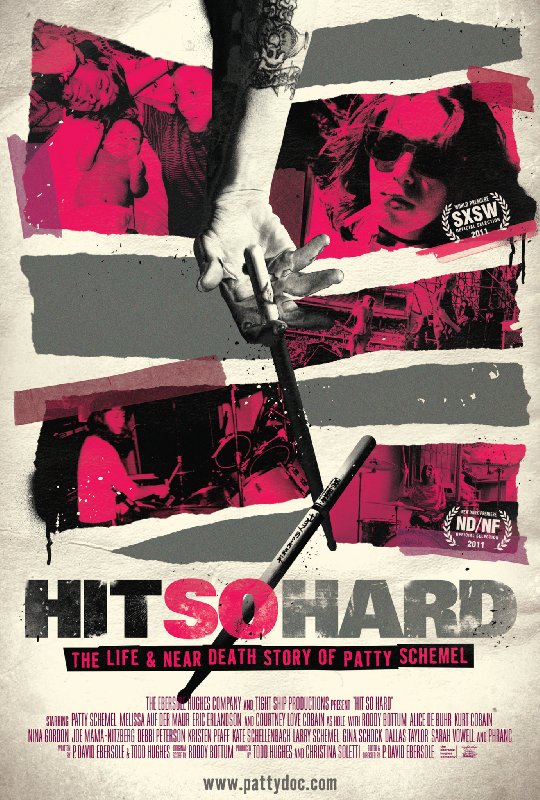
P. David Ebersole and Todd Hughes are the ultimate power duo in the doc world. Their charm, passion for their work, and sheer charisma almost makes me forget that they work behind the camera. We handled festivals and advised on distribution for their 2011 doc Hit So Hard which premiered at SXSW 2011and was released theatrically by Variance. The film was nominated for a GLAAD media award and even helped get the band, Hole, to reunite. In the short time since, they produced conspiracy theory doc Room 237 based on Kubrick’s film The Shining which world premiered at Sundance 2012 and even went to Cannes! The film grossed over $250,000 in its North American release. Ebersole directed and the duo produced the Lifetime Doc Dear Mom, Love Cher.
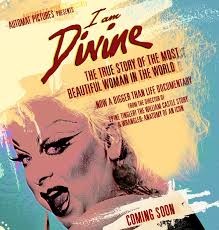
Jeffrey Schwarz’s doc Vito world premiered at NYFF 2011 and screened in Berlin 2012 before opening both Outfest and Frameline and airing on HBO. Like Hit So Hard, it was also nominated for a GLAAD media award. Schwarz is as beloved for his films as he is for his flawless EPK’s. He is back with TFC for his latest doc, I Am Divine, a look at the life and talent of the ultimate John Waters muse which world premiered at SXSW 2013 and was recently acquired by Wolfe Releasing. We are handling festivals and international sales.
Jennifer Arnold’s poignant and inspirational doc A Small Act debuted at Sundance 2010 and went on to air on HBO and was nominated for an Emmy! Since then this dynamo has been hard at work. She directed the doc segments Glee: The 3D Concert Movie, her ESPN doc The Diplomat was just at Tribeca and she has directed for the shows TableTop and Biz Kids.
David Weissman is a San Francisco icon. His films The Cockettes and We Were Here both brought important parts of Gay SF history to a wider audience and world premiered at Sundance. We Were Here went onto screen at Berlin and play a full week theatrical engagement at the 1,400 seat Castro theater. This touching doc on early AIDS activists was released theatrically by Red Flag Releasing, nominated for a Spirit Award and short listed for the Academy Award. Since its release, he has been generating headlines for highlighting his own problems in dealing with the sky high rent of the city and the harm imposed by the Ellis Act. He has since moved to Portland full time where he programs the only Queer Doc film festival in the world.
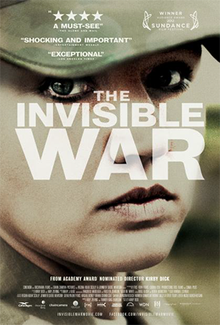
Then there is Kirby Dick and his film The Invisible War. TFC sold the film to New Video and Cinedigm (who have since merged) shortly after it won the Audience Award at Sundance 2012. This hard hitting doc about the rape and sexual abuse of soldiers in the US military has screened multiple times at the Pentagon and been cited for the changes in how the military handles sexual assault cases. It maintains a 100% rating on Rotten Tomatoes and was nominated for an Academy Award. In addition to sales, TFC handled festivals, broadening the stories of these victims’ to be heard all over the world. Given his prolific library of work (he’s had five films in competition at Sundance) we cannot wait to see what he does next.
The Film Collaborative feels very fortunate to have worked with filmmakers of this caliber and we look forward to seeing what the future holds for all of them.
Bryan Glick July 11th, 2013
Posted In: Distribution, Filmmakers of note
Tags: A River Changes Course, A Small Act, David Weissman, documentaries, Hit so Hard, I am Divine, independent film, Jeffrey Schwarz, Jennifer Arnold, Kalyanee Mam, Kirby Dick, Marta Cunningham, P. David Ebersole, The Film Collaborative, The Invisible War, The New Black, Todd Hughes, Valentine Road, Vito, We Were Here, Yoruba Richen
Following up on TFC filmmakers-The narratives
The Film Collaborative has been around for over three years now and in that time we’ve seen our films and members go on to win multiple audience and jury awards at Sundance, get nominated for Oscars and win Emmy’s, last year alone we had 6 films nominated for Independent Spirit Awards.
Not only are we dedicated to our current clients, we are just as invested in our filmmakers’ future projects and we wanted to follow up on what some of our TFC Alumni have been doing. This week we’ll highlight some of our narrative film directors.
Andrew Haigh’s Weekend took SXSW 2011 by storm, won the audience award and was released in the US by IFC/Sundance Selects. Andrew most recently directed an HBO pilot about the lives of gay men in San Francisco that was just picked up to series. The show, starring Jonathan Groff, will premiere in the spring of 2014.
Aurora Guerrero’s debut feature Mosquita Y Mari premiered in the NEXT section at Sundance 2012 and was acquired by Wolfe Releasing. It was nominated for an Independent Spirit Award and Aurora is hard at work on her follow up Los Valientes. She was awarded a $35,000 grant by San Francisco Film Society and we can’t wait to see what she has up her sleeve for this film.
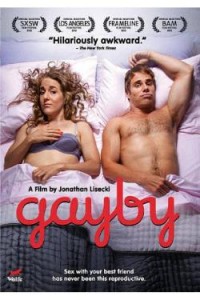
Jonathan Lisecki’s witty banter shined in Gayby which debuted at SXSW 2012. Nominated for a Spirit Award for Best First Screenplay and released by Wolfe, the film has been making audiences laugh around the world. In fact, it reached as high as #5 on iTunes during Pride Week after being chosen as Movie of the Week by Apple. Jonathan co-produced and stars in Big Gay Love opposite Nicholas Brendan (Buffy The Vampire Slayer). The film just screened at Frameline and will be coming to Outfest later this month.
Spike Lee is certainly one of the more prolific filmmakers to come our way. Red Hook Summer premiered at Sundance 2012 and grossed over $300,000 when it was released theatrically by Variance. In what has been a busy year for the bold auteur, his documentary Bad 25 premiered at the Toronto Film Festival 2012 and aired on ABC. He has multiple films lined up in the next year.
Ira Sachs is another indie veteran, but his film Keep the Lights On brought him his widest audience to date. It premiered at Sundance 2012, won the teddy at Berlin, and was nominated for four Spirit Awards. It was snatched up by Music Box and was the highest grossing gay film of the year. Since then, Ira was named a Guggenheim Fellow and his follow up Love is Strange stars Alfred Molina and Michael Gambon.
Special Producers Shoutout
Laura Heberton, who produced Gayby, had Matthew Porterfield’s I Used to be Darker at Sundance this year and Bluebird at Tribeca.
Chad Burris’s film Ass Backwards brought him back to Sundance just one year after Mosquita Y Mari.
Next week we’ll take a look at what our documentary filmmakers are doing now.
Bryan Glick July 3rd, 2013
Posted In: Filmmakers of note
Tags: Andrew Haigh, Aurora Guerrero, Chad Burris, Gayby, independent film, Ira Sachs, Jonathan Lisecki, Keep the Lights On, Laura Heberton, Mosquito y Mari, Red Hook Summer, Spike Lee, TFC filmmakers, The Film Collaborative, Weekend
Social Media Basics for Filmmakers-Youtube
Part 5, the final in our series on social media tools. Find the rest of the series on these links Mindset Change, Myths, Facebook, Twitter
In its 8 short years of existence, Youtube has managed to become a powerhouse online destination for all things video and, according to Nielsen, reaches more US adults ages 18-34 than any cable network. However, 70% of Youtube traffic comes from outside of the US. The site is so active, over 100 hours of video are uploaded every MINUTE and over 6 billion hours of video are watched each month on YouTube—almost an hour for every person on Earth!
Setting up a Youtube account and channel is fairly straightforward. It is generally based on having a Gmail account, which is free, and Youtube channels are also linked to a Google Plus account. Here is a video on creating a Youtube channel
Here is a video on how to create a Youtube channel if you DO NOT want to use a Gmail account:
http://youtu.be/NHRkpYbvSys
In March, Youtube started implementing their new channel layout so if you have a channel that was launched before this time, you will probably find that it looks very different now. Now, there is only one large cover image, just like on Facebook, and it matches the dimensions seen on G+ 2120px by 1192px. All channels have this layout and it is supposed to make it easier for mobile devices to see the channels in a uniform way. Pay special attention to the middle section of your image because on mobile devices, that is what will primarily be seen. Those measurements will be 1280px by 350px.
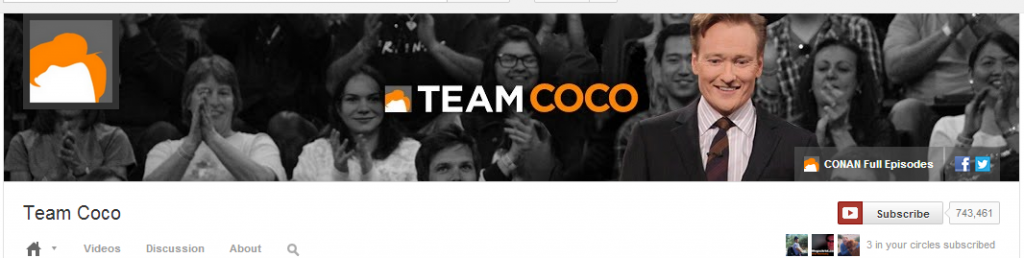
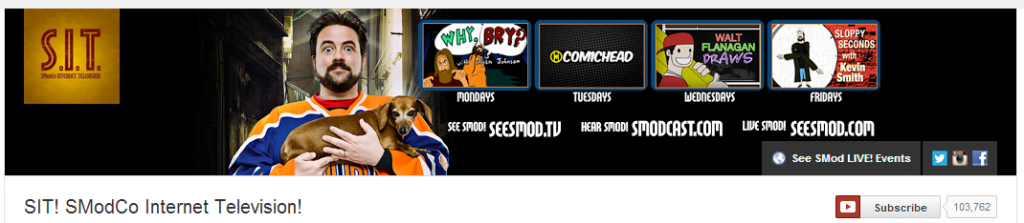
Your cover image is the face of the channel brand. Choose an image that tells a viewer exactly what she is in for when she visits your channel (your brand personality) and what to expect from the project. Also Youtube will prominently display a little “intro to your channel” video for those who haven’t subscribed to your channel yet. It is like a channel trailer or pitch video which lets you highlight your channel’s value and encourages subscribing.
Examples of personality branding on Youtube channels:
As with most things online, you will want to integrate all of your online channels so that the viewer is aware you have them. Add in links to your Youtube channel that include your main website, iTunes URL, Amazon URL, Facebook, Twitter etc. Don’t forget to add new ones all through your production process since you won’t initially have iTunes/Amazon/Hulu etc links.
Be sure to include a call to action on your videos. This can be “subscribe to our channel” “join our email list” with a URL to the sign up page, or “Like us on Facebook.” These calls are best used as speech bubble annotations that flash on the screen while the video plays. You can set this up inside the Youtube video manager setting.
When you don’t yet have a large stockpile of videos created, build up playlists of videos that were not created by you, but suit the interests of your core audience. You can elect to feature these playlists when viewers visit your channel. There is the ability to configure what viewers see on your channel when they visit. Here is a tutorial on how to configure your channel sections:
Ultimately you are trying to build up subscribers on your channel, not just views. In fact, Youtube has recently redone their algorithm to favor videos from channels with a lot of subscribers because they want viewers to keep coming back to the site. If you plan to have a trailer and that’s all on your Youtube channel, you won’t attract many subscribers and you could be penalized in Youtube search. Also, subscribers give you the ability to be in contact with those who liked your video. They can be notified via email and within their homepage news feed when you have uploaded a new video.
A factor in making sure that your video can be found in Youtube search is tagging. Upon uploading a new video, you will be asked to add a title and description for your video. Write titles using a relevant and, hopefully, unique keyword. You can look for keywords using Google Keyword Tool. These same keywords will be used for your tags. Place the most important keywords and keyword phrases at the start of your tags fields. Include common and specific keywords (but not spam) and their misspellings because you want your videos to be found in any way they could possibly be spelled into the search bar. Write 12 or more tags and use as much of the characters as possible. Be sure to use appropriate keywords that will attract interest from potential viewers in your core audience.
Youtube is social, just as all social media is. Interacting with other channels, leaving comments on other’s videos, subscribing to channels, answering comments on your page will help you see better results than simply using the site to host your trailer. If you have other channels hosting your trailer (ie MovieClips or a distributor’s channel), be sure to drop in to those channels and answer comments there too. The most common question is “When can we see this film?” and it will be surprising how little those comments receive an answer. You want people to know when and where the film will be available right? Be sure to answer! Engage your audience!
Having a lot of video responses in your comment section, as opposed to only text comments, will also help indicate to YouTube that your video is popular and relevant and will help with rankings. Respond to comments in the first hours after your video is published because building comments early helps build rankings in YouTube search.
Of course, everyone likes to see their videos getting a lot of views. In fact, having millions of views can turn into media coverage and reaching the trending topics section of Youtube which then perpetuate even more views. There are paid services you can use (see Virool.com or Channel Factory) to help seed your important videos across a network of online sites. These services can be very expensive to use (often $.10-$.15 a click with very high minimums to reach), but this is the way many corporations and Hollywood studios get millions of views to their videos and trailers in a very short amount of time. You didn’t REALLY think that was all organic, did you? Video seeding in essence is paid advertising, but if you need your trailer to go viral, this is the quickest way.
Youtube can be a source of revenue for your production company via embedded advertising if you are generating a lot of views. Revenue will only be significant if you are dedicated to creating video on a consistent basis and growing your subscriber base. For distribution companies, this should be something to add to their revenue streams since they are likely to have the ability to generate a lot of video. Check into joining the Youtube Partner Program for more information.
Youtube has created The Creators Playbook with all kinds of useful information regarding using the site. The Playbook is free and updated regularly.
Sheri Candler June 26th, 2013
Posted In: Marketing, Social Network Marketing
Tags: audience building, independent film, Marketing, socia media basics for filmmakers, YouTube
Social media basics for filmmakers-Twitter
Part 4 in our series on understanding social media tools. Find the rest of the series on these links Mindset Change, Myths, Facebook, Youtube
Time to reiterate…social tools should not be used only as a means of pushing a product. Paid advertising is the best tool to do that. Social media channels are relationship building tools, so if you aren’t interested in a relationship with an audience, you will find minimal success using them. Starting a Twitter account just a few months or weeks prior to the release of your film will not help gain an audience following that will be loyal and actually support your work. A Twitter strategy should not be cold and calculated-buy, buy, buy. It is extremely obvious to anyone using these tools that you are doing this and it is a turn OFF. Approach the online audience on a human level, using a personal voice. It allows a trust to develop and helps garner more loyalty in the long run.
Pew Research recently released its findings on Twitter users. 16% of internet users are active on Twitter, and the service skews towards black and hispanic users, adults aged 18-29, and folks who live in urban areas. It trails significantly behind Facebook as the dominant social channel, but 400 million monthly unique users visit Twitter.com, and 1 billion Tweets occur every 2 1/2 days.*
For now, Twitter is the main site for second screen activity, with 66% of mobile users active on the social network in front of their televisions, and 33 percent Tweet about the shows they’re watching.** If you aren’t engaging on Twitter to find and build a relationship with an audience, you are definitely being left behind. Also it is a great way to network with other industry professionals, some you may never have encountered in your every day life.
How does Twitter work? A little bit like text messaging. You are limited to 140 characters in your messages. But unlike text messaging, your messages aren’t sent to a single person, but anyone that follows you–and viewable by the world and cached by search engines. Bear this in mind before starting an argument online or drunk tweeting! It is possible to send one on one messages, also known as DM or Direct Messages, that are only seen by you and the other person. This only works if you follow each other.
There’s a great list of basic Twitter definitions HERE
When getting started with Twitter, choose your account name with care. It should reflect who you are, your “brand voice,” and attract people to follow you. Ideally, you should use your own name and your profile photo and background images should visually represent who you are or what your project is. Do not pick something cute and nonsensical! As opposed to Facebook, you can change your Twitter name, or handle, and all details about your account with ease on your own, so if you have made the mistake of choosing a Twitter name that doesn’t give good representation of who you are or what you are about, you can change it. All account names will be run through a checker to make sure they are unique so you may have to try a few different names if yours is somewhat common.
Here are a few good examples:
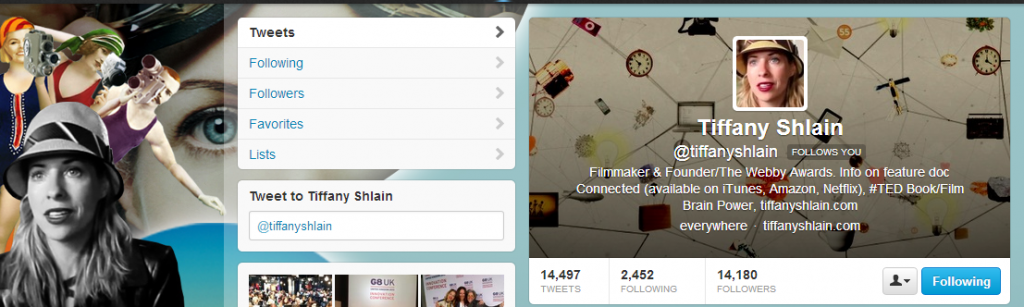
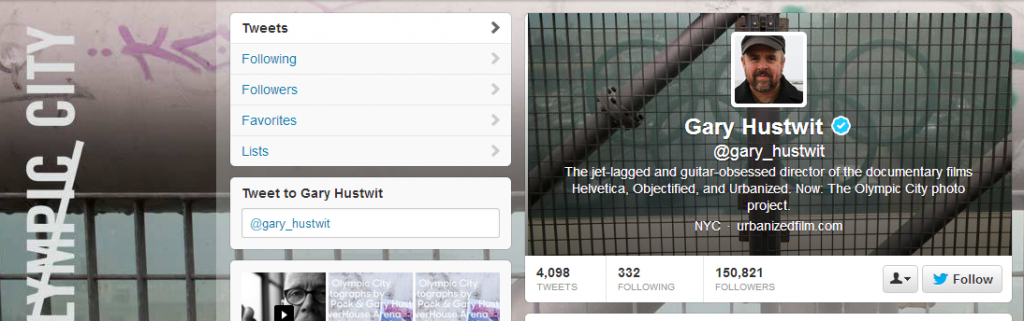
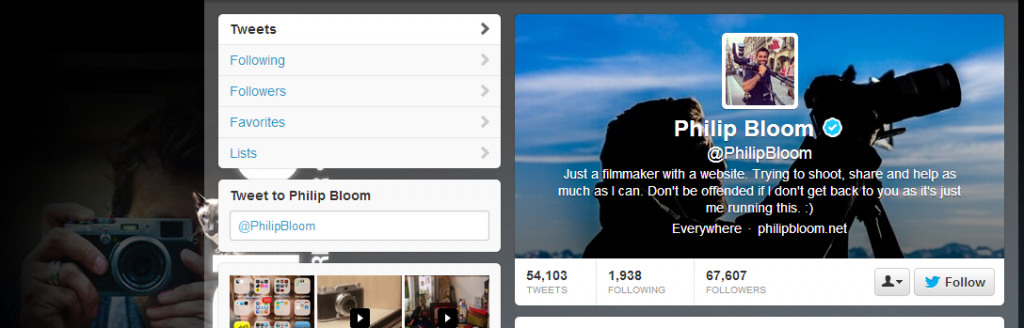
Write a clear, concise bio and include a URL link to your professional website or landing page. There are only 160 characters to use in this About section so get to the point and leave a link for people to click to find out more about you. It is up to you to choose whether to name your location city, but do add the country to give an idea of your origin.
Once you have everything set up on your account to make a good impression to potential followers, let’s find some interesting accounts to follow. Using keywords that reflect the type of creator you are and topics you are interested in, find accounts with similar interests in search tools like Twitter itself, WeFollow, Twellow, and Twiends. Twitter will work best for you if you are following interesting people who offer a lot of value. Often, people give up on Twitter early on because they don’t “get” what the platform does. This is the case when you follow a small group of people who also don’t “get” what the platform does. A useful account will give you great links to information, make connections between you and their following, hold regular conversations and generally use Twitter to make connections with people. Be judicious with whom you follow as your newsfeed will fill up with tweets on a constant basis and you want that stream filled with useful content, not irrelevant or obnoxiously self promotional crap.
For a while, you should only “listen” and take in the way people interact with each other. Best not to start in with “Hi world, I’m on Twitter. Check out my work” because your first impression will not be good. As with all things social media, overt self promotion is not appreciated and won’t win followers straight away. When you do launch in, try responding appropriately to a post someone made or retweeting it. You might also post a useful link yourself, prefacing it with why you think it is useful to those with similar interests.
Now, the thing every filmmaker wants to know. How to get followers? Unless you are a celebrity who has built a vast audience on other media channels, attracting followers will take time and consistent effort. You can buy advertising from Twitter in the form of Promoted Accounts which is part of the “Who To Follow” feature suggesting accounts that users don’t currently follow and may find interesting. More info on that HERE.
You could also go the no monetary cost route by doing these things:
-Make sure that your Twitter handle is posted on all of your communication including email footer and newsletter, website, other social channels, business cards and your official bio that you use in festival catalogs, at the bottom of a guest blog post, really any About You section. The easier you make it to find your Twitter handle, the more followers you will get. Makes sense;
-Tweet interesting things! The more links to great content you post, the more likely people are to retweet (RT) it, thus spreading your Twitter handle to more potential followers;
-Interact with other twitter accounts. Remember, this is conversation in 140 characters. Take few minutes of your day at least twice a day to drop in on those you follow and see what they are talking about. See what you might add to that conversation;
-Post your own links several times a day. The Twitter stream moves very fast so if you post something only once a day, or once every few days, it gets buried quickly. Post several times throughout the day, every day. Where to find these links? Use TalkWalker or Feedly to monitor blogs and publications that post news relevant to your interests and the interests of your audience. You can post these on your other social channels too;
-Take part in Twitter hashtag (#) discussions. On Sunday night, there is a weekly Tweetchat for scriptwriters (#scriptchat). On Wednesdays, a weekly Tweetchat for post production people (#postchat). Almost every film related live event has a hashtag associated (#sheffdocfest, #sundance, #ifpweek, #LAFilmFest etc) and by participating in these events, even if you can’t attend, you will interact with people on Twitter with similar interests and it helps build up a following. You can also do this for events or discussions related to your target audience. Related to hashtag discussions-anytime you post something that is of interest to your target audience, use a hashtag within the tweet so that those who follow hashtags will see it (ie. Making a ballet film? use #ballet. Making a film about civil disobedience? You may want to connect with those following #Taksim or #occupygezi right now). To find popular hashtags, check HERE;
-Did you read a great post or see a great film by someone you want to know on Twitter? Give them an @ mention complimenting their work or sending congratulations. Chances are you will get a follow by that person. Be genuine. Do not use this in an obsequious manner, it is very obvious;
-Include your account to Twitter directories like the ones I mentioned above so your account will be found by others;
-Add a Twitter widget to your website that displays a list of your latest tweets and a button to follow your account. These widgets are plug ins that can be integrated into Tumblr, WordPress, Joomla, Blogger etc platforms. Either ask your developer to integrate it or visit the blog platform FAQ section to find out how.
Most people do not manage their Twitter accounts via the Twitter website and often they use mobile devices rather than a computer. Tools such as Hootsuite allow you to set up columns on one screen to see your newsfeed, your @mentions, your DMs, your Sent tweets and any other keyword or hashtag you want to follow. If you manage more than one Twitter account, you can set that up in Hootsuite too.

As with anything online, you will want to monitor your results. Obviously, you’ll want to see your follower count climbing, but you should also want to know what kind of material you are posting that is making an impact by being shared (RTd), how many people are interacting with you and who they are (these are your super fans), and whether your activity on Twitter is driving interest in your work. Tools like TweetReach, Who Shared My Link?, Who Tweeted Me, and Google Analytics to measure the Twitter traffic to your website. A great article on how to set that up HERE.
A few Twitter DON’TS:
-Don’t autofollow. You want a quality news feed, not one full of useless tweets;
Sheri Candler June 19th, 2013
Posted In: Marketing, Social Network Marketing
Tags: filmmakers, independent film, social media basics, Twitter