ABOUT THE PROJECT
LOGLINE
Through intimate testimony and song, former South African political prisoners reveal how music sustained resistance, unity, and identity within apartheid’s brutal prison system, uncovering silenced histories, especially those of Robben Island and women.
SYNOPSIS
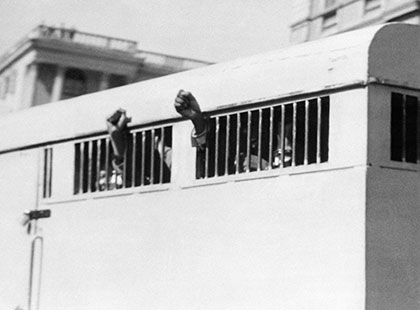
Set against the history of South Africa’s anti-apartheid struggle, WE ARE NOT AFRAID explores music’s critical role as resistance for political prisoners incarcerated over three decades (1960–1990), particularly at Robben Island, the notorious prison where Nelson Mandela was held for 18 years, and the Johannesburg Women’s Jail at the Old Fort. At the heart of the film are deeply intimate, and at times unexpected and humorous personal reflections from former political prisoners, both men and women, who endured imprisonment for their beliefs in racial equality and freedom, and recall how and why they sang or composed music as resistance while in prison. Interweaving first-person interviews with new archival footage from the apartheid era, a rich and textured soundtrack and musical performance, the film reveals how music—including indigenous African genres, migrant work songs, freedom songs, Western classical music, reggae, and rock—provided resistance, critique, community, therapy, memory, and identity. In prison, music often transcended political, linguistic, and ethnic differences, uniting oppressed people against a common enemy. The women’s narratives and songs, in particular, expose a hidden history of state violence: the gendered brutality of incarceration and the struggle against both racial and gender oppression; stories long overshadowed by male-centered narratives of liberation. Through these remarkably resilient individuals, their testimonies, and enduring songs, WE ARE NOT AFRAID raises timeless questions: how does cultural expression become resistance and a force for social change? And what role does music play when the most fundamental rights to human dignity and freedom of movement are under attack? At the intersection of resilience, power, violence, gender, race, memory, and human rights, this film bears witness to the enduring power of song and music in the tightly controlled and limiting space of prison when silence, fear and repression were the regime’s primary goals.
PROJECT TYPE Documentary Feature
DIRECTOR Janie Cole and Shameela Seedat
PRODUCER Janie Cole, Nancy Galdy
EXECUTIVE PRODUCER Lindy Wilson
Cinematographer Theodore Bogosian, Michael Carter, Janie Cole
EDITOR Tonia Moller, Tamsyn Reynolds
WEBSITE musicbeyondborders.net
🎬 Support independent film through The Film Collaborative
The Film Collaborative (TFC) is a 501(c)(3) nonprofit supporting independent filmmakers.
Federal Tax ID: 32-0295081
Your gift is tax-deductible as allowed by law.
💳 Ways to Give
- Online:
Click the Donate button above. You can:- Use your PayPal account, or
- Check out as a guest with your debit/credit card — no PayPal account required.
- ACH or Wire
Email us for instructions.
- Zelle
Email us for instructions.
- Check
Checks are accepted, but for time and security reasons, electronic donations are preferred when possible.
Check donation instructions are here.
- Stock
Donating appreciated stock can increase your impact by up to 20%.
Learn more about advantages of stock donations here.
Email us for instructions.
- Donor-Advised Funds (DAF):
Instructions for donating from a DAF are here.
📈 Maximize Your Gift
- Many employers offer matching gifts, doubling or even tripling your donation. Some match contributions up to a year after they’re made.
- When donating via PayPal, consider covering the small processing fee to make the most of your gift toward the project.
📄 Tax Receipts
- In compliance with IRS rules, tax receipts are issued for the amount TFC receives after payment processor fees are deducted.
- PDF tax receipts are emailed within 30 days of your online donation.
- The “receipt” immediately sent by PayPal is only a payment confirmation — it is not your tax receipt.
Thank you for helping bring powerful independent films to life.
ID: 45